Magyar
 Deutsch
 Español
 Français
 Nederlands
 Polski
 Čeština
 Italiano
 Português
 日本語
日本語 Svenska
 Suomi
Suomi Slovenščina
What happened on June 4, 1976, in Manchester? The complete story and impact of the Sex Pistols concert.
The summer of 1976 in England was sweltering hot and stiflingly boring. In Manchester, hopelessness was the fundamental experience for young people: the charts were dominated by ABBA, and rock music was represented by distant, unreachable "dinosaur" bands. In this stagnant backwater came the explosion at the Lesser Free Trade Hall, which Steve Diggle (Buzzcocks) later simply called:
"The day the punk atom was split." Although there were barely forty people sitting in the audience, many of those present later formed their own bands or fundamentally transformed the British music industry.
THE IDEA OF TWO BOLTON STUDENTS
The concert could not have happened without two Bolton Institute of Technology students, Howard Trafford (later Howard Devoto) and Pete McNeish (later Pete Shelley).
- The spark: In February 1976, they read a short, negative article in the NME (this was one of the very first articles about the Sex Pistols) about a new London band who "want chaos". The famous quote from guitarist Steve Jones - "Actually we're not into music, we're into chaos." - immediately caught their attention.
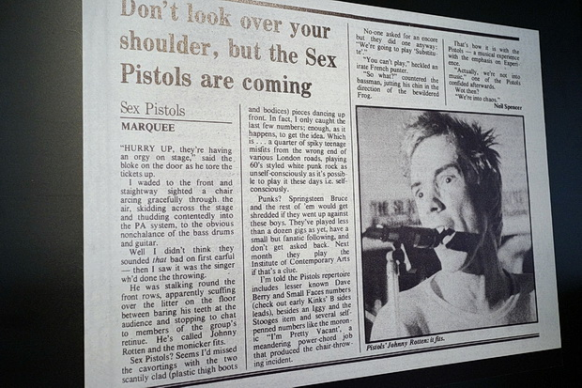
- The meeting: They borrowed a car, traveled to London, and sought out the manager at Malcolm McLaren's shop called Sex. From there, they went to one of the band's gigs, which had a decisive impact on Devoto. After seeing the band live, his life changed radically.
- The organization: They decided to bring the Pistols up north. Their goal was partly selfish: they wanted to secure a gig opportunity for their own forming band, the Buzzcocks. Since there was no dedicated punk club in Manchester, they used their personal contacts to book the hall.
The venue and the conditions
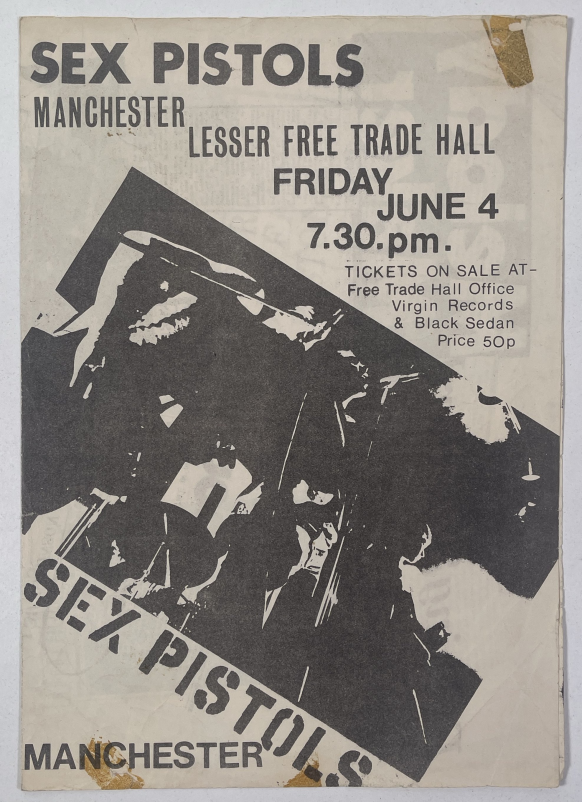
The venue for the concert was the Lesser Free Trade Hall, the smaller, wood-paneled, somewhat cold and stiff auditorium of the larger Free Trade Hall.
- Date: June 4, 1976.
- Ticket price: 50 p
- The environment: There was no pogoing, no pushing. The audience sat on separate chairs, quietly, literally open-jawed, watching the events in shock.
Technical crew and historical documentation
The June 4 gig is one of the most important audiovisual documents in the history of the Sex Pistols. It survived as the second earliest known video recording of the band, and
this is the first recording where not only the visual material, but also the audio of the concert was preserved for posterity.
- Sound engineer: Dave Eyre (he recorded the only surviving audio cassette from this evening).
- Lighting: Neal Holden.
- Visual memories: Paul Welsh took photographs at the venue, and Mark Roberts recorded a part of the concert with a Super 8 camera. The original recording, totaling barely four minutes, is now a highly valuable historical document, the entire material was sold at an auction in 2021 for £15,000. Fortunately, however, several shorter clips have leaked or been made public over the years, so today we can get a glimpse into the atmosphere of the concert based not only on a few still images, but also on motion picture fragments.
THE GIG
The support act eventually became a local hard-rock band,
Solstice, because the Buzzcocks couldn't find a bass player in time, so they couldn't take the stage yet. This also thwarted Howard Devoto and Pete Shelley's original plan to present their own band alongside the Sex Pistols to the Manchester audience.
The Sex Pistols on stage
The Manchester gig was roughly the Sex Pistols' thirtieth concert. Although their national fame was still developing, the band's stage character had become highly recognizable by this time. The band played with raw, confrontational energy, and Johnny Rotten was already dominating the stage with the same provocative presence that later made him one of the most famous figures in punk.
- Steve Jones (guitar): He wore a one-piece boiler suit and played guitar in the style of Pete Townshend (The Who), with theatrical, large arm swings. Years later in an interview, he confessed to Tony Wilson: at the time, he was secretly a huge fan of the American arena-rock band Boston, but as a punk, of course, he didn't dare tell anyone.
- Johnny Rotten (vocals): He stared into the audience with stiff, crazy, fixed eyes. He was unpredictable, insulted the spectators, swore, and provoked the young people who still mostly had a hippie appearance.
The musical turning point: At first, the audience simply didn't understand the noise. According to them, the turning point came during the cover of The Monkees' "(I'm Not Your) Steppin' Stone". This was the moment when the spectators recognized the otherwise hit melody beneath the distorted chaos, and understood what the Pistols were doing: destroying everything their generation believed about pop music.
THE LEGENDARY AUDIENCE "WHOEVER WAS THERE, FORMED A BAND"
According to Manchester legend, thousands now claim to have been there, but in reality, the number of attendees was only between 35 and 40. At the same time, this handful of people who sat in the hall represented the future of British popular music. David Nolan's research pointed out: the magic of the concert lay in the specific Manchester mentality. The spectators didn't think, "Wow, I want to be like this too", but rather: "Come on, I can do a thousand times better than these guys!"
- Bernard Sumner and Peter Hook: After the concert, a fascinated Peter Hook walked into Mazel's music shop in Manchester and bought a bass guitar for £35. They formed a band called Warsaw, which became the music industry-reforming Joy Division, and later New Order.
- Morrissey: He was sitting in the audience, though initially skeptical, and later wrote a critical letter to the NME, criticizing the disharmonious music. He later founded The Smiths.
- Mark E. Smith: The chaos and energy of the night gave him the final push to create The Fall.
- Mick Hucknall: He was also present, later becoming the singer of the world-conquering Simply Red.
- Tony Wilson: As a presenter for Granada TV, he saw the band and decided to bring punk to the screen, and later founded the legendary Factory Records label. (and The Haçienda club).
- Paul Morley: He started writing under the influence of the concert, and later became one of the most defining journalists in the history of the NME.
EMBELLISHED MEMORIES AND REALITY
The mythology of the night has also been deeply absorbed by popular culture, although it has not always remained true to the facts. The opening scene of the cult film 24 Hour Party People, which chronicles the life of Tony Wilson (and the emergence of the Manchester scene), also depicts this iconic concert.
The mythology of the night has also been deeply absorbed by popular culture, although it has not always remained true to the facts. The opening scene of the cult film 24 Hour Party People, which chronicles the life of Tony Wilson (and the emergence of the Manchester scene), also depicts this iconic concert.
"The scene in the film is a great collection of lies, but in a strange way it still completely conveys the essence." – the real Tony Wilson later stated.
The film vs. reality: In the film, the audience is jumping and raging. In reality, however, on June 4, 1976, pogoing hadn't even been invented yet! As the attendees, including Wilson, recalled: people sat stiffly, glued to their seats, quietly, with dropped jaws and in complete shock, watching the four London youths on stage. The jumping in the film is thus just retrospective myth-building and a bit of a fake, but as Wilson said, it brilliantly captures the life-changing energy of the event. (It is interesting to note, however, that in the footage made public in 2021, a few raised hands and some movement can actually be seen in front of the stage.)
THE CONTINUATION
Although six weeks later, on July 20, 1976, the Sex Pistols returned to the Lesser Free Trade Hall for a second gig, where a crowd of hundreds gathered, the pogo appeared, and for the first time
Anarchy in the U.K. was played, and the Buzzcocks also performed successfully, many still trace the birth of British post-punk and independent music culture back to the first night on June 4. That concert, which initially provoked rather incomprehensible shock, set in motion processes that fundamentally changed the music scene of Manchester, and then all of Great Britain.
Fifty years later, it is hard to imagine that one of the most important moments in the history of modern British alternative music was seen on the spot by just a few dozen people. Yet, on that night in Manchester, it wasn't simply a concert taking place – a new era was born.
FIND OUT MORE
The impact and legend of the concert has occupied music historians and fans ever since. Over the years, numerous books and documentaries have been made about it, among which perhaps the most important materials are the following:
-
Book:
David Nolan: I Swear I Was There: The Gig That Changed the World (2006)
(The most comprehensive research on who was actually present on that particular summer night.) -
Documentary 1:
I Swear I Was There (2001)
(Television documentary created by David Nolan featuring the recollections of the original attendees.) -
Documentary 2:
Granada TV – Mark Radcliffe report (1996)
(Granada TV documentary hosted by Mark Radcliffe, broadcast in 1996.) -
Full audio recording of the concert:
Sex Pistols live Lesser Free Trade Hall Manchester (June 4th, 1976)
-
Rare video footage: Auction TV report excerpt